GPT-6 Astra: From AI Assistant to Autonomous AI Agent
GPT-6 Astra marks a major shift from traditional AI assistants to autonomous AI agents, capable of handling complex tasks such as coding, research, web browsing, and multi-step workflows with greater independence.
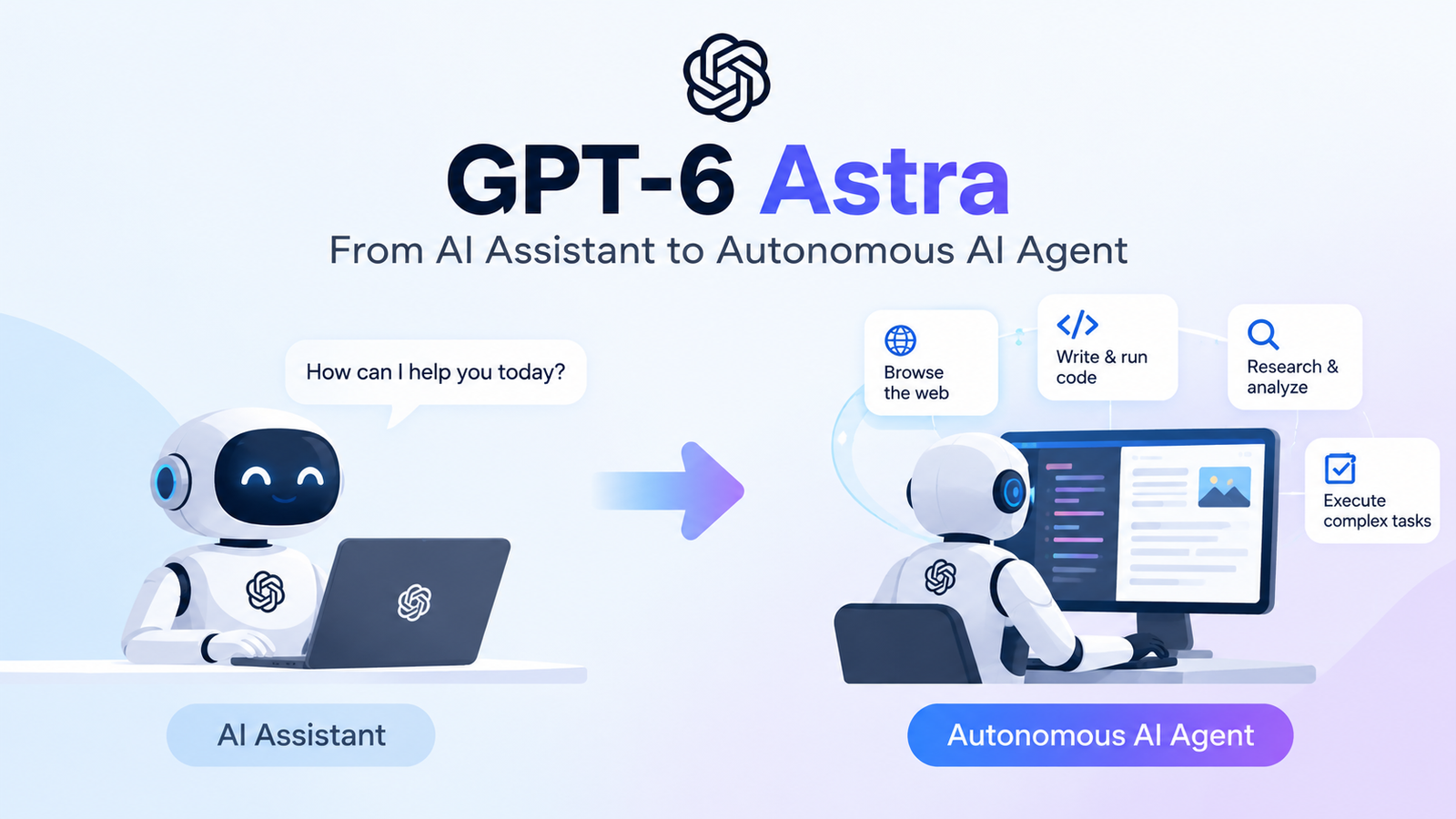
GPT-6 Astra Explained: From AI Assistant to Autonomous AI Agent
For the last few years, "using AI" meant a fairly predictable loop: you wrote a prompt, the model gave you an answer, and you decided what to do with it. Even the most advanced assistants needed you to define the method, break the task into steps, and check the output at every turn.
That loop is starting to break down. On September 3, 2026, OpenAI released GPT-6 Astra, and the headline isn't really about raw intelligence scores — though those jumped too. It's about what happens when you stop treating an AI model like a tool you operate and start treating it like a worker you delegate to.
This post walks through what Astra actually is, how it differs from the assistant-style models that came before it, and what its arrival signals for developers, businesses, and everyday users.
What Is GPT-6 Astra?
GPT-6 Astra is OpenAI's newest frontier model, built to operate software — browsers, spreadsheets, IDEs, document editors — on its own, over long stretches of time, without a human checking each step. It's rolling out across ChatGPT Plus, Pro, Business, and Enterprise plans, the OpenAI API, Microsoft Azure, and Amazon Bedrock.
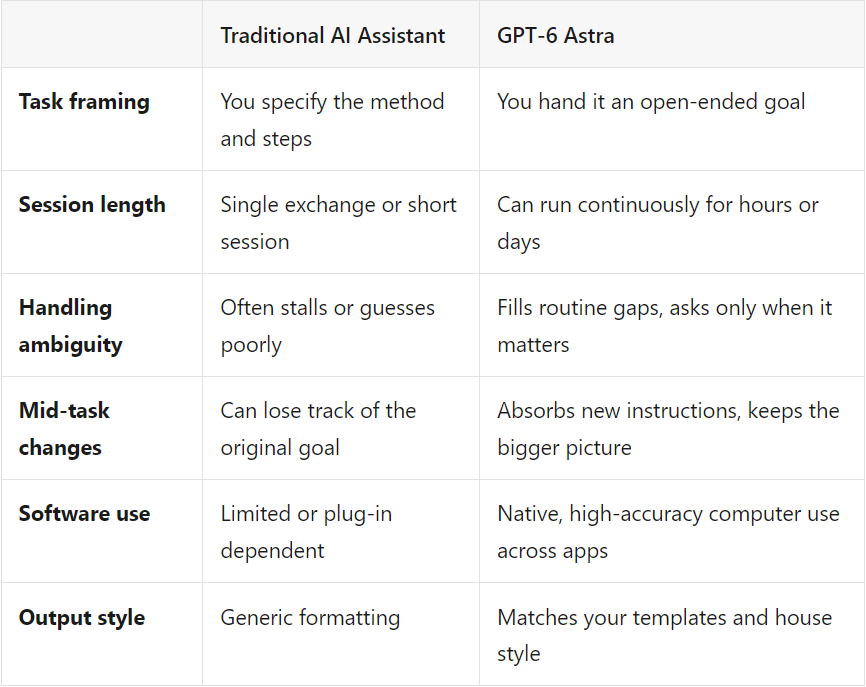
Where earlier models were assistants you prompted one exchange at a time, Astra is designed to be handed an open-ended goal — "organize my inbox," "migrate this database," "build a working prototype" — and figure out its own method, recover when something breaks, and keep going for hours or days without supervision. OpenAI president Greg Brockman has gone as far as suggesting the model may represent the arrival of artificial general intelligence, while leaving the final judgment to users.
Key Features of GPT-6 Astra
Long-running autonomy
Astra doesn't just complete a single request — it can stay on a task for extended periods, picking its own tools and adjusting course as circumstances change. One widely discussed example involved a user handing Astra years of emails, a calendar, and a contacts list, then leaving it to build a personal knowledge system over several unsupervised days.
State-of-the-art computer use
Astra is OpenAI's best model yet at directly operating a computer: filling out forms, updating CRM records, navigating unfamiliar software, and running QA checks on a live website. On internal latency testing, it reportedly completes computer-use tasks in roughly half the time of its predecessor while scoring meaningfully higher on accuracy.
Judgment when instructions are incomplete
Instead of stalling out on ambiguity, Astra is tuned to fill routine gaps with reasonable assumptions and only ask a clarifying question when the answer would materially change the outcome — and it can keep working on unrelated parts of a task while waiting for your reply.
Staying on-task through changing instructions
Earlier models sometimes treated a mid-task correction as an entirely new request, losing the thread of the original goal. Astra is built to absorb new constraints, change direction when asked, and still return to the broader task afterward.
Professional-grade output
Astra is tuned to match existing templates and house style — producing slides, spreadsheets, and documents that look like they came from inside your organization rather than a generic AI export, and pulling in only the context that's actually relevant instead of padding outputs with boilerplate.
Frontier coding ability
OpenAI positions Astra as its strongest software engineering model so far, with gains not just in raw code generation but in the broader arc of agentic coding: understanding a codebase, testing changes, and communicating its reasoning in a way that's easier for developers to follow.
Real-Life Example: A Household Move
To see what "autonomous" actually looks like in practice, consider a task like planning a household move — something that spans research, scheduling, and paperwork rather than a single clean instruction.
Handed the goal directly, Astra can research moving companies and compare quotes, cross-reference your calendar to propose moving dates, draft a change-of-address checklist, and start filling out utility transfer forms — checking in only when a decision genuinely needs your input, like which mover to book. Rather than you managing ten separate ChatGPT conversations for each sub-task, Astra treats the move as one connected project and keeps the state of that project in its own head across a much longer working session.
GPT-6 Astra vs. Previous Assistant-Style Models
Benefits
Cuts down on the constant back-and-forth of "prompt, check, re-prompt" for multi-step work
Handles genuinely tedious, multi-app busywork — form-filling, data entry, research summaries — with far less oversight
Produces documents, slides, and code that better match an organization's existing standards out of the box
Frees people up to focus on the decisions that actually need human judgment, rather than every step along the way
Reports meaningfully faster task completion than its predecessor on computer-use benchmarks, at lower estimated cost per task
Limitations & Risks
Astra's autonomy is exactly what makes it useful — and exactly what makes it worth being careful with.
Cybersecurity risk: OpenAI has classified Astra as reaching a "critical" threshold for cybersecurity capability under its internal safety framework, meaning it can identify and develop working exploits with limited human guidance. Its most advanced cyber capabilities are being rolled out gradually and only to vetted defenders for now.
Prompt injection exposure: Because Astra can act on untrusted content it browses or opens, there's real risk of hidden instructions embedded in a webpage or document redirecting its behavior — something OpenAI has run dedicated red-teaming against, though no safeguard is airtight.
Long, unsupervised runs need real guardrails: A model working for days without a human checking in raises the stakes of small errors compounding, so organizations still need review checkpoints and permission boundaries rather than a fully hands-off setup.
It's not infallible judgment: Filling gaps with "reasonable assumptions" is helpful most of the time, but for consequential decisions, human review is still essential — the model is built to defer on those, not to guarantee it always gets the line right.
Cost and access: Standard API pricing runs at $10 per million input tokens and $50 per million output tokens, with a faster processing mode available at double that rate — worth factoring in for high-volume or long-running agentic workloads.
Who This Affects
Developers get a coding collaborator that can work through larger refactors and multi-step debugging without losing context across a long session, and one that OpenAI says communicates its reasoning more legibly along the way.
Businesses and knowledge workers get an agent that can absorb the genuinely repetitive parts of professional work — form-filling, report drafting, spreadsheet building — in a format that already matches internal templates, rather than something that still needs heavy reformatting afterward.
Security teams face a double-edged development: the same exploit-finding ability that helps defenders patch vulnerabilities faster also raises the bar for what a misused version of this technology could attempt, which is why OpenAI is staging access to its most sensitive capabilities.
Everyday users get help with the unglamorous life admin — appointment scheduling, research-heavy comparisons, paperwork — the kind of task that's simple in principle but tedious enough that it usually gets put off.
Conclusion
The real story of GPT-6 Astra isn't a benchmark chart — it's a shift in what "delegating to AI" even means. For years, the model was the one being managed. With Astra, more of that management starts flowing the other way, and the skill that matters most may no longer be writing the perfect prompt, but knowing exactly which decisions you still want to make yourself.
Frequently Asked Questions
Is GPT-6 Astra available to everyone?
It's rolling out in stages — starting with a limited set of organizations, then extending to ChatGPT Plus, Pro, Business, and Enterprise users, as well as the OpenAI API, Azure, and AWS Bedrock. Enterprise workspace admins need to enable it, as it's off by default at launch.
How is Astra different from a regular chatbot?
A regular chatbot responds to one prompt at a time and waits for your next instruction. Astra can take a broad goal, choose its own approach, operate software directly, and keep working across a much longer session with minimal check-ins.
Does GPT-6 Astra pose security risks?
Yes — OpenAI has classified it as reaching a critical threshold for cybersecurity capability, meaning it can find and exploit software vulnerabilities with limited human guidance. Its most advanced cyber capabilities are being released gradually and mainly to trusted defenders for now.
What can GPT-6 Astra actually do with a computer?
It can navigate browsers, fill out forms, work inside spreadsheets and document editors, write and test code, and build things like websites, slide decks, and simple games — largely by operating the same software a person would use.
How much does it cost to use via the API?
Standard pricing is $10 per million input tokens and $50 per million output tokens, with a faster mode available at roughly double the price.